
Water Damage Restoration What It Really Costs: What Murrieta Homeowners Pay in 2026
Water damage restoration in Murrieta typically runs between $1,200 and $8,400 for a single affected room, with whole-home events from a slab leak or supply-line failure commonly reaching $15,000 to $35,000 once structural drying, demolition, and rebuild are factored in. The spread exists because two quotes for the same visible wet drywall are rarely scoping the same job. One accounts for what the moisture meter found inside the wall cavity. The other assumes the fan will handle it. If you’d rather not sort through that math on your own, call (844) 643-8708 and we’ll walk the property with you.
The $1,200 water damage quote and the $8,400 quote for what looks like the same loss area are usually both technically accurate. The cheaper one assumes Category 1 water on the surface of the drywall, no cavity penetration, and a few days of air movement. The more expensive one accounts for Category 2 water that wicked into the insulation, soaked the bottom plate, and is now feeding microbial growth behind the baseboard. Neither estimate writer is lying. One of them never pulled a moisture reading behind the wall. In Murrieta, where summer heat accelerates evaporation into living spaces and winter storm cycles push groundwater against slab foundations, that difference determines whether you’re paying for drying or paying for a rebuild in six months.
What Actually Drives the Cost: Loss Category, Square Footage, and Drying Time
Restoration pricing follows a defensible structure. Three variables do the heavy lifting, and everything else on the invoice is downstream of these.
Loss category. The IICRC S500 standard classifies water damage into three categories. Category 1 originates from a sanitary source: a supply line, a faucet, an ice maker line. Category 2 carries contaminant load: dishwasher discharge, washing machine overflow, sump pump failure. Category 3 is grossly contaminated: sewage backup, floodwater, toilet overflow past the trap. Each step up changes the labor profile. Category 3 requires full PPE, controlled demolition of affected porous materials, antimicrobial treatment, and often negative air containment. That’s why a 200-square-foot sewage loss in a Maple Street bathroom can cost more than a 400-square-foot supply-line loss in a living room. Contamination drives cost independently of square footage.
Affected square footage. Water spreads until it hits a barrier. In a slab foundation home in Murrieta, that barrier is often an interior wall plate or a stair framing member. Restoration estimators use a moisture meter to map the actual migration path, not the visible staining. What looks like a six-foot puddle in the kitchen may have traveled fifteen feet through the wall cavity into the adjacent laundry room. Square footage for restoration is calculated by affected materials: square feet of drywall to be cut, linear feet of baseboard to be removed, square footage of carpet and pad to be extracted or discarded.
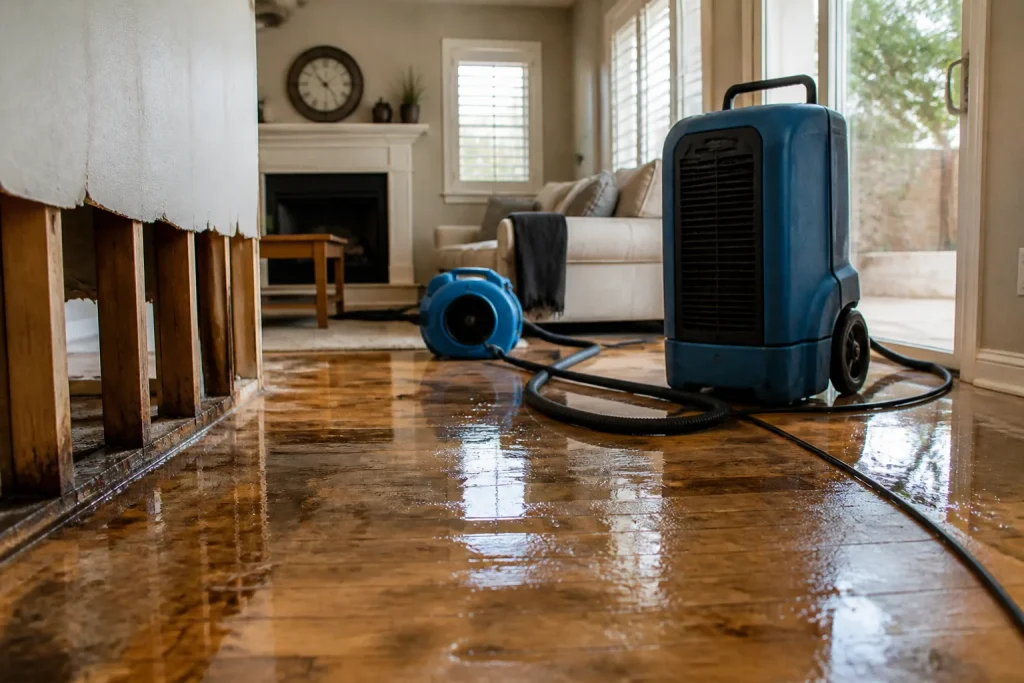
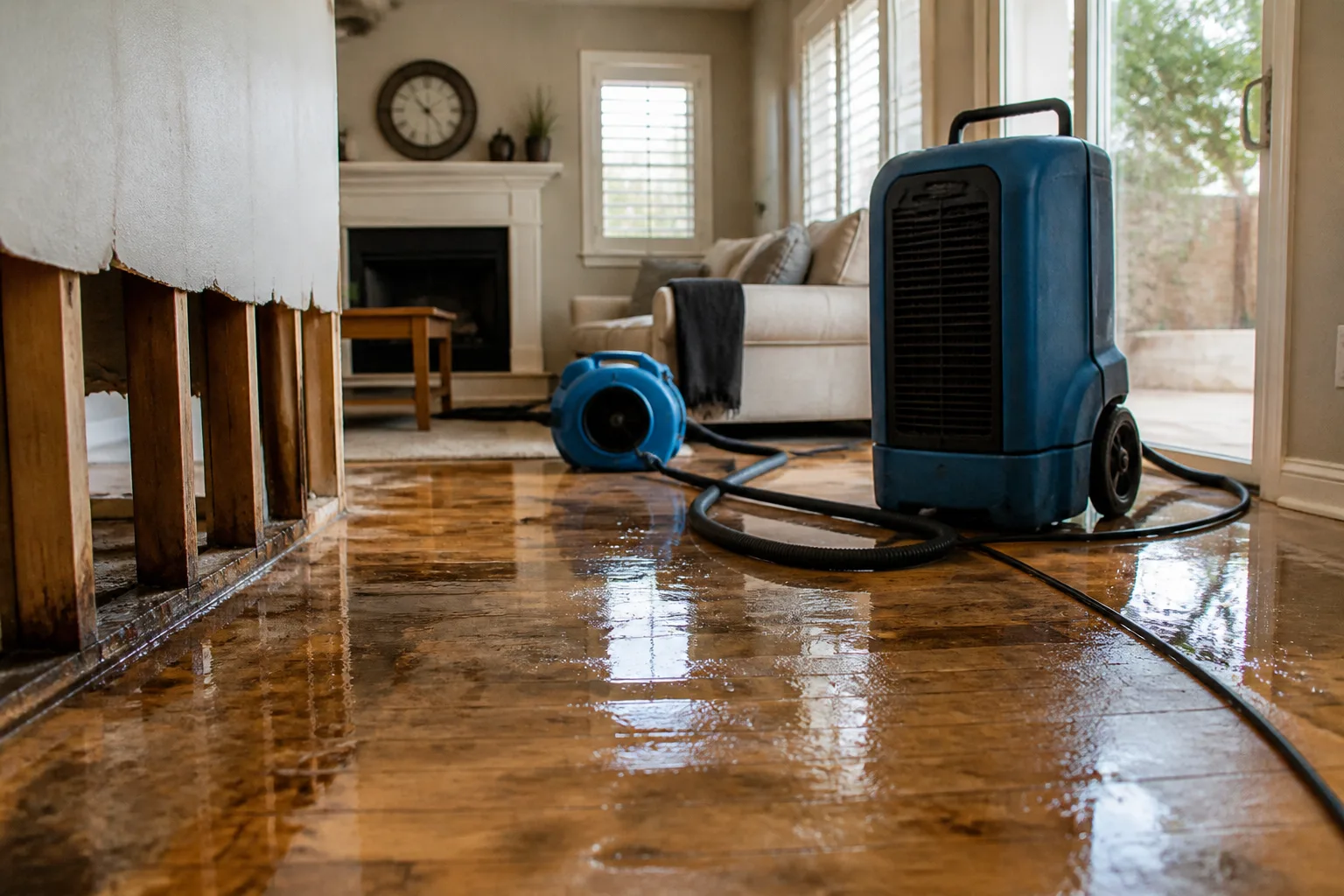
Equipment deployment duration. Structural drying requires a calculated number of air movers and LGR (low-grain refrigerant) dehumidifiers running for a calculated number of days. A proper dry-out of a saturated 10×12 room with wet insulation typically requires 3 to 5 days of continuous equipment operation. Each air mover and dehumidifier carries a daily cost. Here’s where scope manipulation happens: under-deploying equipment extends drying time, which increases the daily equipment charges and introduces secondary damage risk. A properly sized drying array that resolves the loss in 4 days costs less than a two-fan setup that runs for 11 days and still leaves elevated moisture readings in the drywall. Drying science, not guesswork.
Cost Breakdown by Loss Category: What Murrieta Homeowners Actually See
Here’s what a residential restoration invoice should look like in 2026, broken down by contamination level. These are realistic working ranges for Murrieta’s market, not national averages.
| Loss Category | Typical Scope | Cost Range | What’s Included |
|---|---|---|---|
| Category 1 | Supply line leak, single room, no cavity penetration | $1,200 – $3,500 | Extraction, drying equipment for 2-4 days, baseboard removal, minor drywall repair, moisture monitoring |
| Category 1 Extended | Slab leak or supply line affecting multiple rooms, cavity drying required | $4,000 – $11,000 | Extraction, Injectidry in-place drying, demolition of saturated drywall, 3-7 days equipment, antimicrobial treatment, drying logs |
| Category 2 | Dishwasher or washer overflow, contaminated water in wall cavities | $3,500 – $8,500 | Removal of affected porous materials, PPE, antimicrobial application, drying equipment, cavity inspection, disposal |
| Category 3 | Sewage backup or floodwater, any square footage | $6,000 – $18,000+ | Full PPE, containment, controlled demolition, antimicrobial treatment, disposal of contaminated materials, drying, documentation for insurance |
These numbers shift based on whether your home sits on a slab or a raised foundation. Raised foundation homes in Murrieta’s older neighborhoods, particularly around the historic downtown corridor, often have crawlspaces that complicate drying. Subfloor cavity drying with Injectidry systems allows us to dry floor joists and subfloor from below without cutting open the finished flooring above. That one decision can save thousands in flooring replacement costs. A restoration company that doesn’t offer in-place cavity drying will default to demolition every time.
The Equipment Cost Model: Why Properly Sized Drying Costs Less
Every day a dehumidifier runs in your home, you’re paying for that equipment day. Here’s the math that separates legitimate restoration companies from the floor-fan-and-a-prayer crowd.
An LGR dehumidifier like a Dri-Eaz or Phoenix unit removes 70 to 130 pints of water per day depending on conditions. A saturated 10×12 room with wet drywall and carpet pad holds roughly 20 to 35 gallons of water in materials. At 70 pints removed per day, one properly rated LGR dehumidifier working alongside three to five air movers can resolve that room in 3 to 4 days. That’s 3 to 4 equipment days per unit.
Now under-deploy. Two air movers and a homeowner-grade dehumidifier from a big-box store pull maybe 25 to 30 pints daily under ideal conditions. Dry-out takes 11 to 14 days. That’s 11 to 14 equipment days per unit, plus the secondary damage that accrues while materials stay wet: warped baseboards, delaminating drywall, microbial growth in the wall cavity. The cheap scope just became the expensive scope, and the invoice for extended equipment rental erases the initial savings.
We deploy commercial-grade drying equipment from Dri-Eaz, Phoenix, XPOWER, B-Air, and Injectidry on every job because the math works in the homeowner’s favor. A drying array sized to the actual gallons of water present resolves the loss faster. Faster resolution means fewer equipment days, less disruption, and lower total cost. It’s not a boutique approach. It’s how commercial restoration has always worked, applied to residential losses.
What Your Xactimate Estimate Should Include in 2026
Xactimate is the estimating software most insurance carriers and restoration companies use to build scopes and settle claims. If a restoration contractor in Murrieta hands you a handwritten one-page number, that’s not inherently a problem for small losses. For anything beyond a single-room Category 1 event, the estimate should be itemized, and it should contain specific line items.
Here’s what belongs on a properly scoped residential restoration estimate in 2026:
- Water extraction per square foot – Line item, not bundled into a round number.
- Structural drying equipment per day – Air movers and LGR dehumidifiers, listed as separate line items with quantities.
- Moisture mapping and monitoring – Daily moisture readings documented in a drying log, not “checked on it once.”
- Containment barrier – Plastic containment to isolate the affected area from the rest of the home, standard for Category 2 and 3 losses.
- Antimicrobial or biocide application – Required for any Category 2 or 3 loss, and recommended for Category 1 losses that sat longer than 48 hours.
- Demolition and debris disposal – Cut drywall, removed baseboard, carpet pad, insulation, all bagged and hauled.
- HEPA vacuuming – Post-demolition particulate capture, not sweep-up.
- Contents manipulation – Moving, protecting, or packing out furniture and personal property.
Here’s what should alarm you: no line item for antimicrobial treatment on a Category 2 loss. No demolition line item when the moisture meter registered elevated readings in the wall cavity. No drying log or monitoring schedule. A quote that says “dry out: $1,800” as a single line item is not a scope. It’s a guess. And in Murrieta, where many homes were built in the 1980s and 1990s with drywall-on-slab construction, moisture wicking up from a slab foundation is common enough that every legitimate scope should include cavity inspection.
We pulled one out of a garage off Clinton Keith Road last month where a water heater had been weeping for weeks before anyone noticed. The garage slab looked dry. The moisture meter read 28% at the wall plate. The water had migrated under the base of the drywall, wicked into the studs, and was feeding mold inside a wall that shared space with the kitchen pantry. The restoration scope wasn’t just a garage dry-out. It was a kitchen pantry wall, a section of subfloor under the water heater closet, and a containment barrier for the mold remediation that followed. The initial visibly affected area was about twelve square feet. The actual affected area was over 200.
Murrieta Insurance Dynamics: What You Owe and What the Carrier Covers
Murrieta’s insurance market in 2026 is tighter than it was three years ago. Several major carriers have pulled back from California wildfire-exposed zones, which has shifted homeowners toward a smaller pool of active insurers. What that means for water damage claims is practical: adjusters are scrutinizing scopes more carefully, and homeowners are more frequently contests about what constitutes “covered loss” versus “maintenance issue.”
Here’s how a standard homeowners policy handles water damage:
- Sudden and accidental discharge – A supply line that bursts, a water heater that fails catastrophically, an ice maker line that lets go. Covered, minus your deductible.
- Gradual damage – A pinhole leak behind a wall that’s been seeping for six months, a shower pan failure that rot the subfloor over two years. Carriers often deny or limit these claims as maintenance issues. Document everything. A restoration company that produces photo documentation and moisture readings from day one gives your adjuster evidence to work with.
- Sewer backup or floodwater – Standard policies exclude these. If you have a water backup endorsement or separate flood policy, it applies. Murrieta sits in a region where flood risk is real for homes near Murrieta Creek and its tributaries, and standard homeowners policies do not cover surface water intrusion.
- Over-limit costs – If restoration exceeds your coverage limit, you owe the difference. This is another reason a tight scope matters up front. A bloated estimate eats coverage room you might need for reconstruction.
Assignment of benefits (AOB) was banned in California for property insurance contracts since 2019, so in Murrieta you cannot sign away your benefits to a restoration contractor the way homeowners still do in other states. What you can do is have a restoration company that documents to IICRC standards, works directly with your adjuster, and provides photo documentation for every stage of the loss. That’s how certified restoration companies like ours approach it. Whitehall Water Damage holds credentialing through IICRC, RIA, and IFA, which means our scopes are built to published industry standards that adjusters recognize. If we’re not on your policy’s preferred list, our documentation still speaks the same language your adjuster uses.
Restoration vs. Reconstruction: Where the Invoices Split
Restoration ends when the structure is dry. Reconstruction begins when drywall goes back up, flooring gets reinstalled, and paint goes on. Two different scopes, two different crews on most projects, and in Murrieta, two different invoices.
The threshold where restoration-plus-reconstruction becomes one integrated project is usually Category 2 or 3 water affecting multiple rooms, anything involving sewage or floodwater, and any loss where demolition is required to access contaminated cavities. For a Category 1 supply-line leak in a single room with no cavity penetration, you might pay $2,800 for restoration and $3,000 for a separate drywall and paint contractor. For a Category 3 sewage loss affecting a bathroom and adjacent bedroom, the restoration and reconstruction work typically merge into a $25,000 to $40,000 project where demolition, drying, rebuild, and finish work all appear on one scope, one timeline, one responsible party.
Whitehall Water Damage covers the full damage triangle: Water Damage Restoration in Murrieta, Mold Remediation in Murrieta, and Fire Damage Restoration in Murrieta. That means when a water loss leads to mold in the wall cavity, one credentialed team handles both events without a handoff to a third party. No subcontractor shows up unfamiliar with your loss history. No second company re-reads the moisture map for the first time. The restoration company you called at 2 a.m. is the same company that gets the structure dry, treats the microbial growth, and documents the entire chain for your adjuster.
When to Call a Pro Instead of Handling It Yourself
Small clean-water spills on hard surfaces: a mop and a fan will do. The moment water contacts drywall, baseboard, carpet, or any porous material, the clock starts. Within 48 hours, microbial growth becomes a real possibility in Murrieta’s climate, where interior temperatures above 75 degrees and elevated humidity create ideal conditions. Here’s when DIY stops being viable:
- Water has migrated under baseboards or into wall cavities
- The loss originated from anything other than a clean supply line (dishwasher, washer, toilet, sump, sewage)
- Any area larger than a single room is affected
- Flooring shows cupping, buckling, or swelling
- You smell must, dampness, or sewage
- The water sat for more than 24 hours before discovery
If any of these apply, call (844) 643-8708. The estimate is free, and you’ll get a written scope based on moisture readings, not a guess from someone standing in your doorway.
Related services in Murrieta: Whitehall Water Damage home
The Bottom Line
Water damage restoration pricing in Murrieta follows a structure anyone can learn to read. Loss category determines labor profile. Affected square footage determines demolition and drying array size. Equipment deployment duration determines daily equipment cost. When a quote seems too low, it’s usually omitting a line item, not offering you a bargain. When a quote seems too high, ask for the line items. A legitimate restoration estimate survives that question easily. One built on a round number does not.
What you want on the invoice: moisture readings, equipment quantities, daily drying logs, antimicrobial treatment where applicable, photo documentation, and a scope written to IICRC S500 standards. What you want on the job site: commercial-grade equipment from manufacturers that do this for a living, a credentialed crew, and one company that handles water, mold, and fire without handoffs. In Murrieta, where homes are built on slabs and summers run hot, a half-scoped dry-out turns into a mold problem faster than people expect. Get the scope right the first time.
If you’re in Murrieta and need help, Whitehall Water Damage offers free estimates with a written scope before any work begins. Call (844) 643-8708.
Frequently Asked Questions
Most Murrieta homeowners pay between $1,200 and $8,400 for restoration of a single affected room, depending on water category and whether cavity drying is required. Whole-home events from slab leaks or supply-line failures typically run $15,000 to $35,000 when restoration and reconstruction are both included. The cost is driven by loss category, affected square footage, and equipment deployment duration, not by company markup alone. Call (844) 643-8708 for a free estimate based on moisture readings.
Sudden and accidental water discharge, like a burst supply line or water heater failure, is covered under a standard Murrieta homeowners policy minus your deductible. Gradual damage from long-term leaks, sewer backups, and floodwater are typically excluded or require separate endorsements. Photo documentation and drying logs from the restoration company give your adjuster the evidence needed to settle the claim. Always confirm coverage with your carrier before authorizing work.
Structural drying for a properly sized equipment array typically takes 3 to 5 days for a single saturated room. Larger losses with cavity drying through Injectidry systems may run 5 to 7 days. Demolition, antimicrobial treatment, and reconstruction add additional time beyond the drying phase. A drying log with daily moisture readings tells you exactly where the structure stands at every point in the process.
If water has contacted drywall, baseboard, or any porous material, fans alone will not remove moisture from wall cavities or subfloor spaces. Murrieta’s warm climate accelerates microbial growth once materials stay wet past 48 hours. Professional restoration with moisture mapping, commercial-grade drying equipment, and daily monitoring removes the water you can’t see. If the loss is anything more than a clean spill on tile, call (844) 643-8708 for a free assessment.
Written by the team at Whitehall Water Damage, serving Murrieta since 2015.
Need Damage Restoration Help?
Call Whitehall Water Damage — licensed & insured, here with fast after-hours help in Murrieta.
(844) 643-8708