Last updated October 30, 2026
 Water damage drying
 Fire & smoke cleanup
 Mold remediation
 Storm response
 Sewage cleanup
 Reconstruction
Free visual inspection and a written scope of work before any mitigation begins - photos, moisture readings, and drying logs go in your claim file
The scope we write is the scope we bill. Anything new gets shown to you, in writing, before we touch it.
Get your free estimateHow to Hire a Damage Restoration Contractor in Murrieta: A Step-by-Step Guide
In Murrieta, the wrong restoration contractor decision doesn’t just cost money. It costs time. And with water damage, time is structure. Mold colonization begins within 24 to 72 hours. Every hour spent comparing quotes from unverified contractors is an hour that moisture keeps wicking up drywall, delaminating laminate, and saturating subfloor. What follows is not generic hiring advice. It’s the vetting sequence we use when we walk into a loss and see what happened after another contractor got there first.
Restoration work we handle
Quick Answer
The right damage restoration contractor in Murrieta should hold IICRC certifications you can verify on the public registry, operate commercial-grade drying equipment rather than consumer hardware, and document every moisture reading, photo, and work phase in writing. Before signing anything, check their CA Contractor’s State License Board standing, verify their IICRC certifications by name and number, and read the contract language for any Assignment of Benefits clause that transfers your insurance claim control to the contractor.
Table of Contents
- The Real Risk Window: Why 24-72 Hours Changes Everything
- Step 1: Verify Credentials Before Anyone Touches the Property
- Step 2: Identify Predatory Contract Language (AOB Tactics)
- Step 3: Evaluate Equipment Quality On-Site
- Step 4: Ask About Documentation Protocol Before Extraction Starts
- Step 5: Know the Murrieta-Specific Red Flags
- The Hiring Sequence: A Step-by-Step Action Plan
- Common Mistakes to Avoid
- When to Call a Professional
- Frequently Asked Questions
- The Bottom Line
The Real Risk Window: Why 24-72 Hours Changes Everything
Water damage is the only major property loss that gets structurally worse by the hour. Fire damage is done when the fire is out. Wind damage stops when the storm passes. Water damage accelerates. Within the first day, water spreads laterally through flooring and vertically through wall cavities. By day two, drywall becomes a growth medium. By day three, mold spores that were already present in every Murrieta home find the moisture they need to colonize. What started as a category 1 clean-water event from a supply line is now a category 3 contamination event. The cost to remediate has tripled, and the insurance adjuster is asking why mitigation didn’t start sooner. Our Water Damage Restoration Troubleshooting: Common Problems and How to Fix Them covers the early warning signs that help homeowners act before this escalation.
This is the context most hiring guides ignore. They tell you to get three quotes, compare reviews, take your time. That advice works when you’re hiring a painter. It is actively harmful when you have standing water in a Murrieta home with summer temperatures that push indoor humidity higher and accelerate microbial growth. The sequence that follows is built for the reality that you’re making this decision under time pressure, not after a leisurely weekend of research.
Step 1: Verify Credentials Before Anyone Touches the Property
The first thing to understand: a logo on a business card means nothing. A certification is verifiable. The Institute of Inspection, Cleaning and Restoration Certification (IICRC) maintains a public registry where you can look up any certified technician by name or business. If a contractor claims IICRC certification, ask for the technician’s name and certification number, then confirm it on the registry. It takes ninety seconds.
Three specific IICRC certifications matter for damage restoration, and they are not interchangeable:
- Water Restoration Technician (WRT) – The baseline certification for water damage restoration work. Confirms the technician understands extraction, drying science, and moisture measurement.
- Applied Structural Drying (ASD) – A higher-level certification focused specifically on drying complex structures: wall cavities, subfloors, multi-level properties. This is the cert you want when the damage extends beyond a single room.
- Applied Microbial Remediation Technician (AMRT) – Covers mold remediation protocols, containment, and safe removal practices. Necessary for any job where mold is present or likely to grow.
The contractor who tells you “we’re certified” without specifying which certifications and who holds them is often certified in the sense that they paid a website developer to put the word on their page. At Whitehall Water Damage home, our technicians hold WRT and ASD certifications, and our Mold Remediation in Murrieta work falls under AMRT protocols. You can ask for specific names and numbers. Any legitimate operation will provide them without hesitation. If the response is vague or deflecting, that is your answer.
Beyond individual certifications, look for membership in industry associations. The Restoration Industry Association (RIA) is the trade organization for restoration professionals, with a membership requirement that includes adherence to a code of ethics. The IFA, which covers fire and related damage restoration, is another signal of accountability to a body outside the contractor’s own office. A contractor holding certifications from multiple organizations is subject to multiple standards. That is a feature, not an accident.
Step 2: Identify Predatory Contract Language (AOB Tactics)
The contractor who arrives first after a major water event has a psychological advantage. You are stressed, the damage is spreading, and someone competent is finally here. That moment of relief is the window where storm-chasing operations get you to sign something you haven’t read.
Riverside County, including the Murrieta area, has seen out-of-area contractors appear after major rain events with aggressive door-to-door tactics. The most dangerous document they push is an Assignment of Benefits, typically called an AOB. Here’s what it does: you sign over your insurance claim rights to the contractor. The contractor becomes the party that deals with your insurer, receives your claim payout, and decides what to charge. You step out of the process entirely.
California restricts AOB use in insurance contexts, but predatory contractors have developed workarounds: work authorization forms with embedded clauses that function like AOBs, direct payment authorizations that route your entire claim to the contractor, and “service agreements” that are not labeled as AOBs but accomplish the same thing. The tell is always the same language: any clause that gives the contractor authority to communicate with your insurer on your behalf, negotiate your claim, or receive payment directly from your insurer.
Before you sign anything at the door:
- Read the entire document. Not skim it. If the contractor rushes you, that’s a signal.
- Look for the phrase “assignment of benefits” or “assignment of rights.” Do not sign it.
- Look for language about the contractor communicating with your insurance company on your behalf. That is a claim control transfer.
- Ask for a written scope of work before any work begins. If the contractor cannot provide it, walk away.
- Check that the contractor holds a valid California Contractor’s State License Board license. Verify it on the CSLB website by license number and confirm the name matches the one on the document.
A legitimate restoration contractor in Murrieta works with your insurer, not around you. Our process at Whitehall Water Damage includes a written scope of work agreed before equipment gets placed. Your insurance claim remains yours. We document, we communicate, we bill, but we never ask you to sign away your standing in your own claim.
Step 3: Evaluate Equipment Quality On-Site
Restoration is an equipment business. The quality of the drying result is determined by the quality and configuration of the machines brought to the loss. If you know what to look for, you can assess a contractor’s seriousness in the first five minutes after the truck opens.
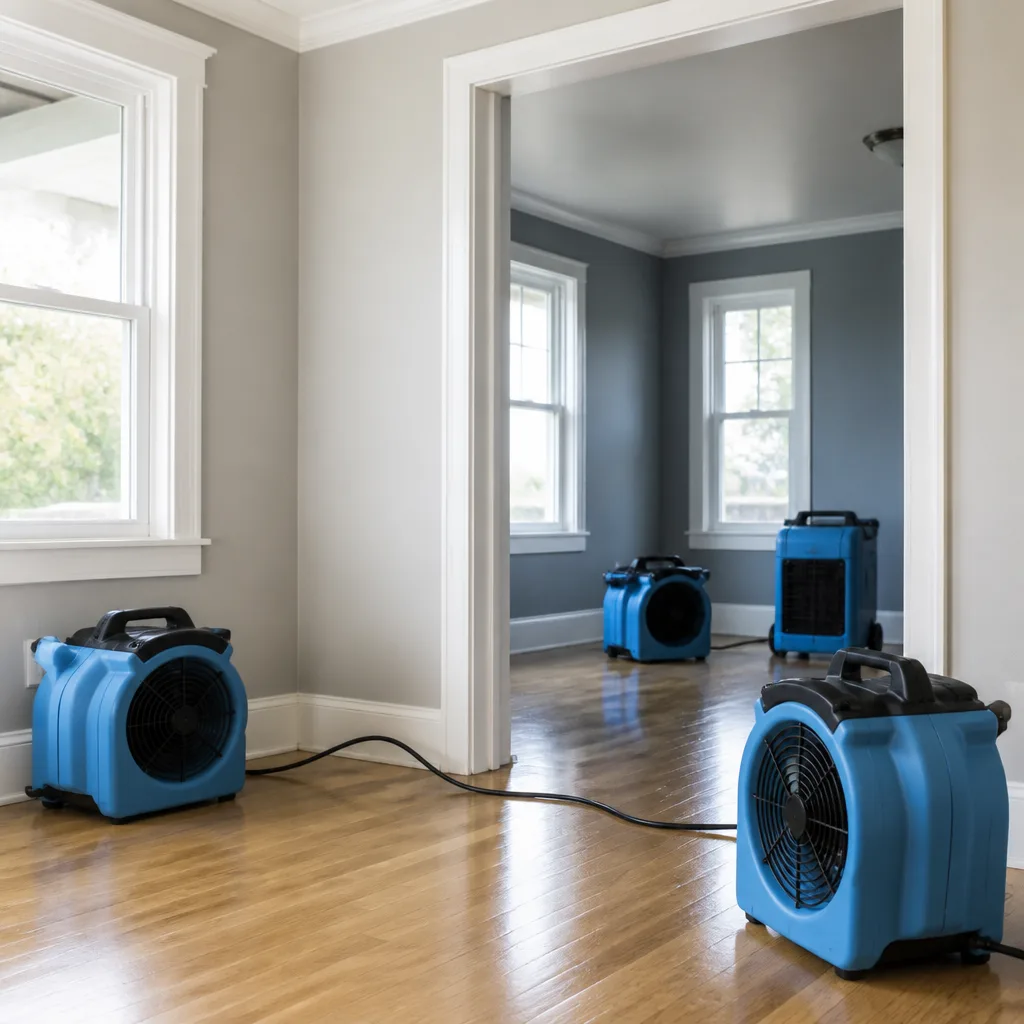
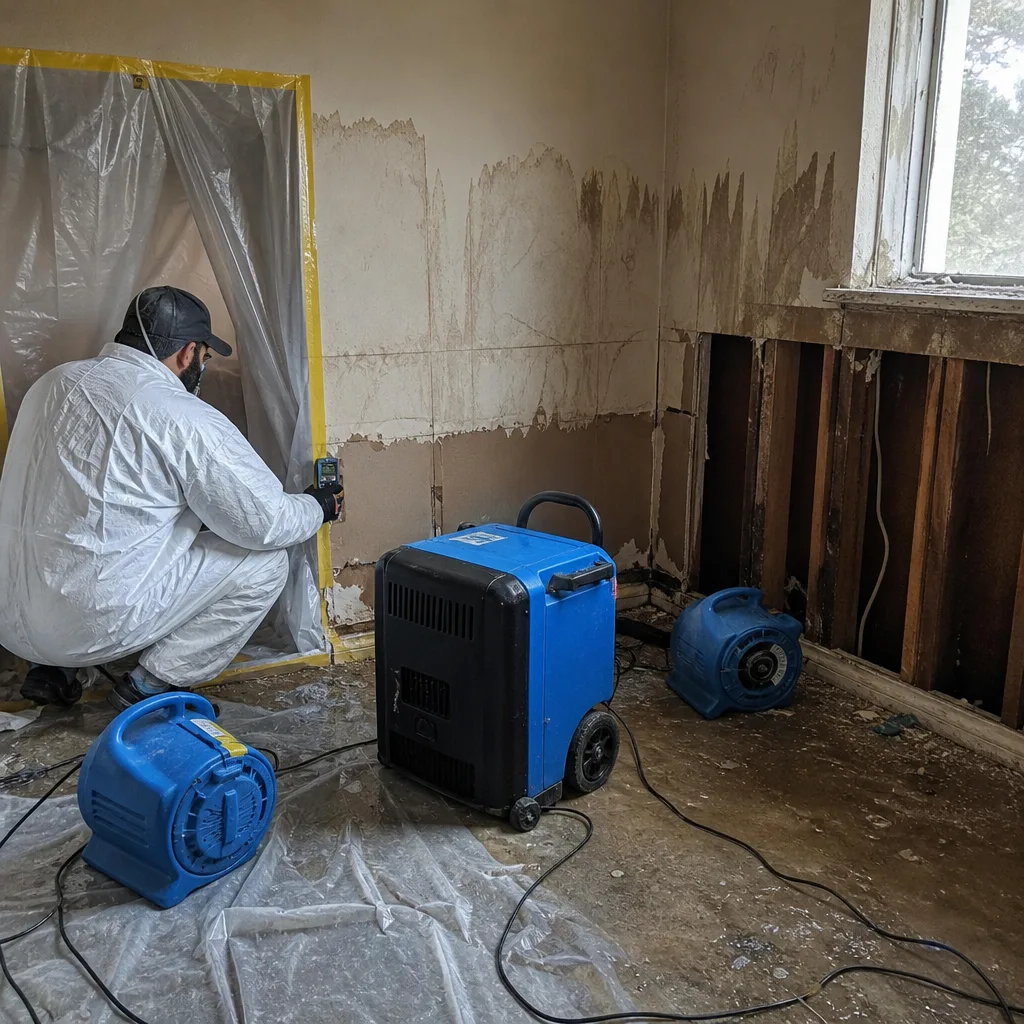
Professional drying uses low-grain refrigerant (LGR) dehumidifiers. These are distinct from the small dehumidifiers sold at hardware stores. LGR units pull significantly more water per kilowatt hour and continue extracting at lower humidity levels. Pair them with high-velocity air movers positioned to create calculated airflow across wet surfaces, and you have the baseline of a professional drying system.
The brands you see on a professional truck indicate the equipment tier. Dri-Eaz, Phoenix, XPOWER, and B-Air are the four most common professional-grade brands in the restoration industry. If the contractor shows up with a single residential dehumidifier from a hardware store, that is not a drying system. It is a gesture. It will extend the drying timeline, and that extended timeline will increase your total cost and the probability of secondary damage.
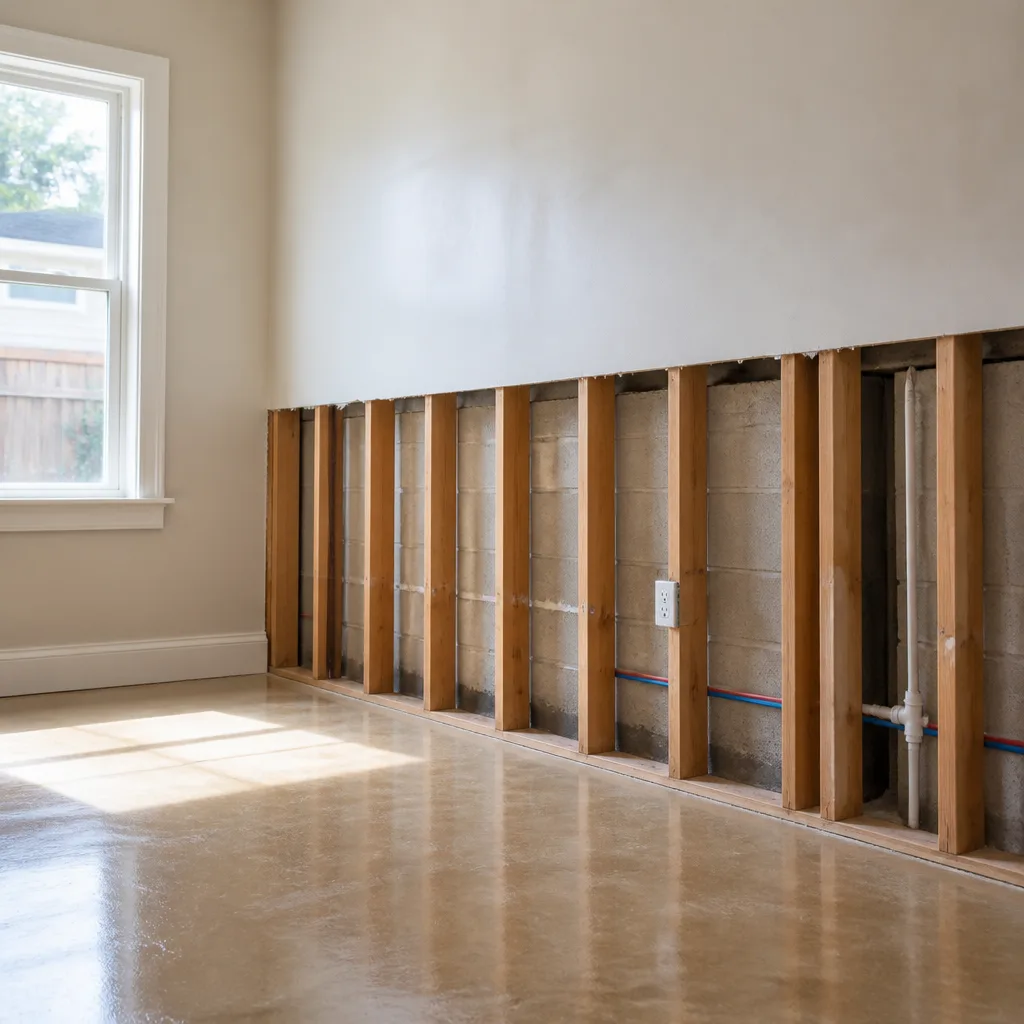
There is also a specific tool that separates prepared contractors from generalists: Injectidry systems. These are used for targeted in-place drying of wall cavities and subfloors, the spaces behind the drywall and below the flooring where moisture is invisible. Traditional drying means tearing out the drywall to expose the framing, then replacing it later. Injectidry pushes air into the cavity through small ports, allowing the hidden space to dry without demolition. In Murrieta homes, where many structures use multi-layer flooring and finished basements, this capability often means the difference between a few days of drying and weeks of reconstruction.
Our Water Damage Restoration in Murrieta service deploys LGR dehumidifiers, professional air movers, and Injectidry systems as the situation requires. If a contractor cannot name the equipment they’ll use, they likely don’t own it. And if they don’t own it, they’re renting it, which means they’re not investing in the tools of their own trade.
Step 4: Ask About Documentation Protocol Before Extraction Starts
Your insurance claim lives or dies on documentation. The insurer was not present when the pipe burst. They will adjudicate your claim based on what the contractor records. Ask these questions before the first piece of equipment enters the house:
- Do you take daily moisture readings? Professional drying uses moisture meters to measure and log readings from walls, floors, and structural materials every 24 hours. These readings form a drying curve that proves the structure moved from wet to dry. Without them, there is no evidence that drying was complete or necessary.
- Do you capture psychrometric readings? These are the temperature and relative humidity measurements that tell a technician how effectively a drying system is removing moisture from the air. They’re not optional. They’re the data that confirms the drying system is working.
- Do you provide photo documentation at every phase? Before extraction, after extraction, during drying, and after completion. Photos that capture the extent of damage are direct evidence for your claim.
- Will I receive a written restoration plan? A scope of work, an expected timeline, equipment list, and daily progress documentation. This document is what your adjuster will compare against industry standards.
Contractors who answer these questions with “we’ll handle it” are not following IICRC standards. The IICRC’s S500 Standard for professional water damage restoration requires documented moisture measurements, documented drying goals, and daily monitoring. A contractor working to that standard will show you the logs because the logs are the product. They are how you know the work was done correctly even when the result is invisible inside a wall cavity.
Step 5: Know the Murrieta-Specific Red Flags
Murrieta sits in the Temecula Valley with a climate that creates specific damage patterns. Hot, dry summers reduce ambient humidity and can make drying progress faster if managed correctly. But the region’s occasional intense winter rain events bring concentrated water damage spikes. That is when the storm chasers appear. Our Seasonal Damage Restoration Care for Murrieta: Year-Round Homeowner’s Guide breaks down how to prepare for each season’s distinct risks.
Here are the red flags that are particularly relevant to homeowners in Murrieta and surrounding southwest Riverside County:
- Out-of-area license plates and phone numbers. After major storms, contractors from outside the region arrive in Murrieta with rental equipment and high-pressure tactics. Verify that any contractor you consider actually holds a California CSLB license with a local or verifiable business address. The CSLB website allows you to check license status, bonding, and any enforcement actions.
- No local references or local restoration history. A legitimate Murrieta restoration company can name neighborhoods it has worked in: Murrieta Hot Springs, Bear Creek, Copper Canyon, Vintage Reserve. Ask directly: “Where in Murrieta have you worked recently?” A vague answer is an answer.
- Immediate payment demands. Restoration work is typically billed through the insurance claim process. A contractor demanding full payment at the time of service, before any insurance determination, is operating outside standard protocol.
- Single-service operations masquerading as full restoration. Water damage in a Murrieta home can cascade into mold within 72 hours. If the contractor does water but not mold, you’ll be handed off to another company when the mold appears. One credentialed team handling the Fire Damage Restoration in Murrieta work, the water mitigation, and any resulting mold remediation means continuity and accountability. Look for contractors with the full damage triangle in-house.
- The “special pricing for Murrieta homeowners” pitch. There is no special pricing. Restoration is billed against documented work and insurance agreements. Anyone offering a deal outside that framework is either cutting corners or inflating elsewhere.
The Hiring Sequence: A Step-by-Step Action Plan
When water is actively spreading or smoke residue is still in the air, you do not have time for a relaxed evaluation process. This sequence is built for the emergency timeline and can be completed in under an hour:
- Shut off the water source or contain the damage. If safety permits, stop the flow. This is not contractor work. This is homeowner first response.
- Call your insurance company and open a claim. This should happen in parallel with contractor evaluation, not after. Your insurer can also recommend restoration contractors they have worked with before. That recommendation is not a mandate. You choose the contractor.
- Search for local restoration contractors. Look specifically for Murrieta-based or southwest Riverside County-based companies. Verify CSLB license for each.
- Verify IICRC certifications on the public registry. Ask for the certifying technician’s name and number. Confirm WRT and ASD for water damage, AMRT for mold.
- Ask the documentation questions from Step 4. If the answers are not specific and confident, move to the next contractor.
- Request a written scope of work. Before any work begins. This protects you and is a legal requirement for most insurance-billed restoration work.
- Review the contract for AOB or claim-control language. Do not sign anything that transfers your standing in your own claim.
- Confirm equipment and monitoring plan. LGR dehumidifiers, professional air movers, daily moisture readings, psychrometric logs. These are non-negotiable for any professional drying job.
- Approve the scope and begin mitigation. Once you have verified the contractor, approved documentation protocol, and reviewed the contract, move. Time is structure.
The sequence ends with mitigation starting as quickly as possible after verification. This is the variable that most hiring advice treats as flexible and most real damage events punish.
Common Mistakes to Avoid
- Waiting for “confirmation” before calling anyone. The 24-72 hour mold window does not wait for your schedule. Call the moment the damage is discovered even if you’re still deciding how to proceed. A phone call is not a contract.
- Choosing a contractor based on the number of trucks in their fleet. Fleets can be rented. Certifications cannot. Equipment quality and documentation protocol matter more than marketing presence.
- Assuming your homeowner’s policy covers everything. Policy language varies widely on water damage categories, mold remediation coverage, and gradual damage exclusions. Ask your adjuster directly what is covered before you assume. The contractor can document, but only your policy decides.
- Signing a work authorization at the door without reading it. The urgent moment is the danger moment. Storm chasers depend on time pressure. A legitimate contractor will give you time to read, even in an emergency.
- Hiring a water-only company for what will likely become a mold job. In Murrieta’s climate, water damage left untreated becomes mold. If your contractor cannot handle both, you’ve hired two separate projects, two separate claims, and two separate handoffs.
- Focusing on visible damage during the walkthrough. The real damage is often behind walls, under flooring, and inside cavities. A contractor using only visual inspection is not measuring moisture. Invisible moisture is where the structural loss happens.
- Paying upfront for restoration work. Standard industry practice is billing through the insurance process or milestone-based invoicing. Upfront full payment is a strong signal of a problematic operation.
When to Call a Professional
Any water event that soaks porous materials: drywall, carpet, subfloor, cabinetry, or insulation, requires professional drying. Surface wiping and a box fan will not dry a wall cavity. Any visible mold growth larger than a small localized patch requires containment and professional removal. Any fire event, even a small one, requires professional soot and odor treatment; smoke residue is carcinogenic and permeates every porous surface in the affected room. Sewage backups and toilet overflows are category 3 water events and carry pathogenic risk. If you are uncertain about the category or extent of your damage, get a professional assessment. Whitehall Water Damage offers free estimates in Murrieta. Call (844) 643-8708 and we’ll assess the situation, document what we find, and provide a written scope of work before any equipment is placed.
Frequently Asked Questions
Visit the IICRC’s public registry website and search by the technician’s name or certification number. Any legitimate contractor will provide this information without hesitation. If they hesitate, that is a red flag. Confirm the certification is current; IICRC certifications require ongoing continuing education.
Coverage depends entirely on your specific policy language and the cause of the damage. Sudden and accidental water events, like a burst supply line, are commonly covered. Gradual damage, like a slow leak over months, is frequently excluded. Mold remediation coverage varies significantly by policy. Contact your adjuster immediately when damage occurs and document everything.
Most residential drying jobs in Murrieta complete within 3 to 5 days when commercial-grade LGR dehumidifiers and professional air movers are deployed with daily monitoring. In-place drying with Injectidry systems can shorten timelines for wall cavities and subfloors because demolition is avoided. The timeline depends on the water category, materials affected, and the drying system’s capacity. For a structured approach to staying ahead of these variables, see our Water Damage Restoration Maintenance Checklist for Murrieta Homeowners.
An AOB transfers your insurance claim rights to a third party, usually the contractor, who then deals directly with your insurer and receives your claim payout. It removes you from the process entirely and creates significant risk of inflated billing and claim disputes. California restricts these agreements. If a contractor asks you to sign an AOB or similar document, decline and find another contractor.
Depends on the contractor. Some operations do water only and refer mold work elsewhere. Others, like Whitehall Water Damage in Murrieta, handle water damage, mold remediation, and fire damage restoration with the same credentialed team. For a water event that may cascade into mold, having one team capable of both eliminates handoff delay and accountability gaps.
A detailed written scope of work listing the affected areas, the proposed drying or remediation method, the equipment to be used, the monitoring plan with daily moisture readings, the estimated timeline, and the payment structure tied to insurance processing. If the contract lacks this specificity, do not sign it. Ask for the document in writing before any work begins.
The Bottom Line
Hiring a damage restoration contractor in Murrieta is a high-stakes decision made under time pressure. The wrong choice costs more than money: it costs the structural integrity of your home and the strength of your insurance claim. Verify credentials on the public IICRC registry. Read every contract for AOB language. Confirm commercial-grade drying equipment and daily documentation before work starts. Watch for the local red flags that appear after every major rain event in southwest Riverside County. The best contractor is one who operates to a documented standard, shows you the documentation, and handles water, mold, and fire damage under one roof. That is how restoration should work, from the first call to the final moisture reading. For more guides & resources on protecting your home, explore our blog.
Written by the team at Whitehall Water Damage, serving Murrieta since 2015.
See the difference
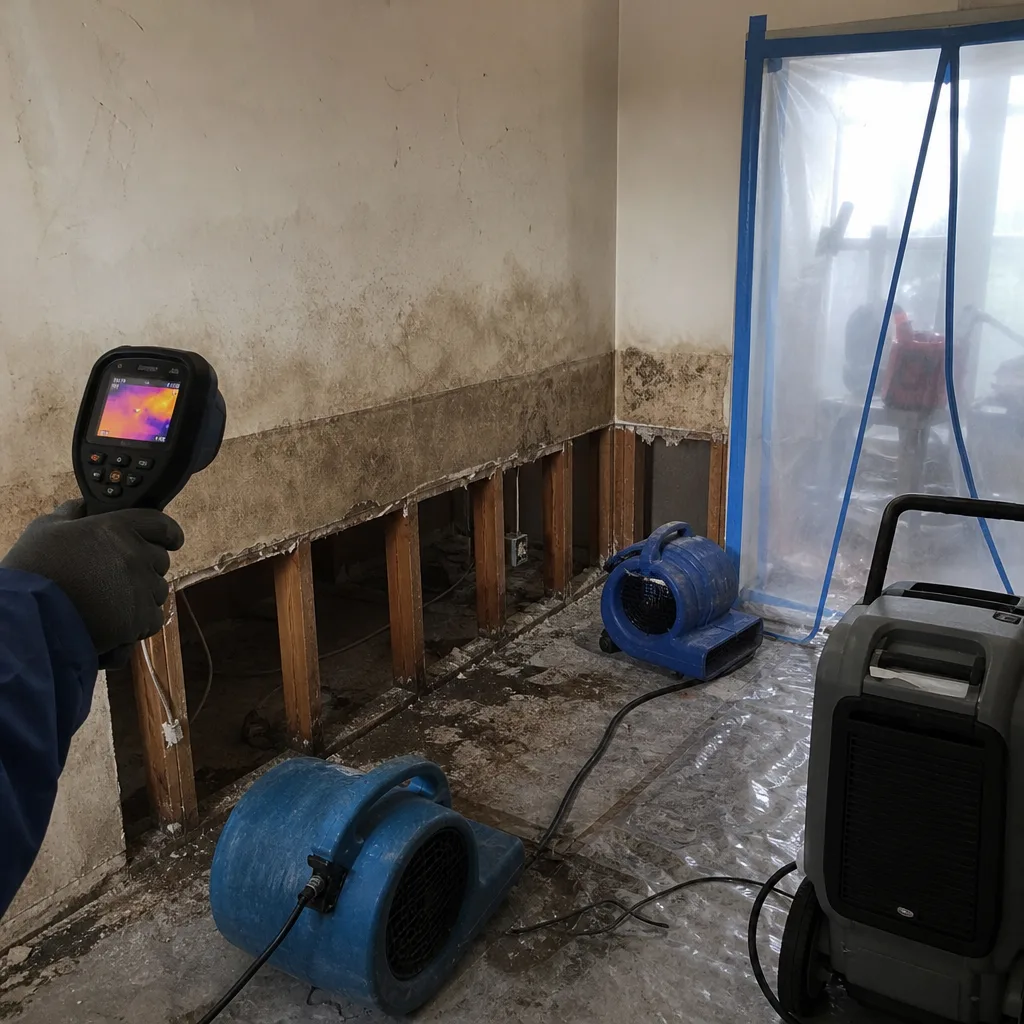 Before
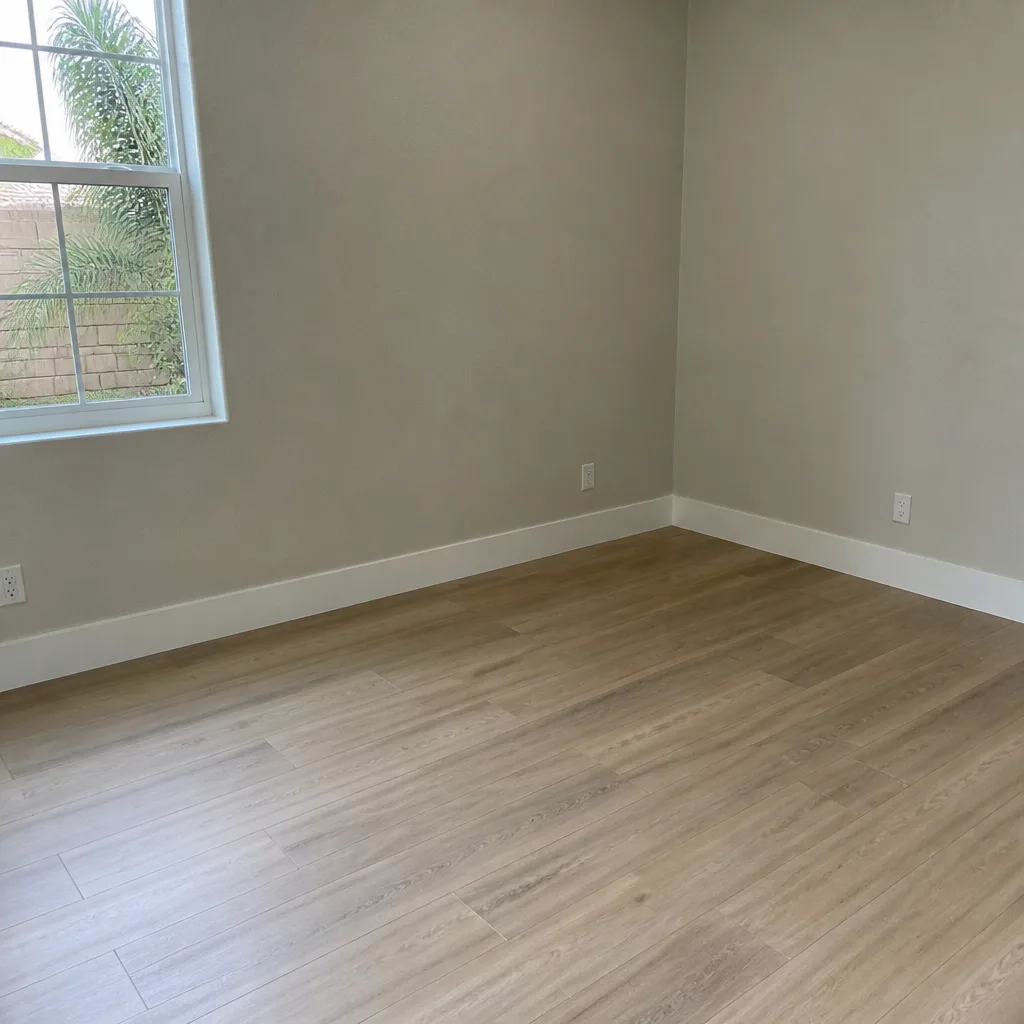 After
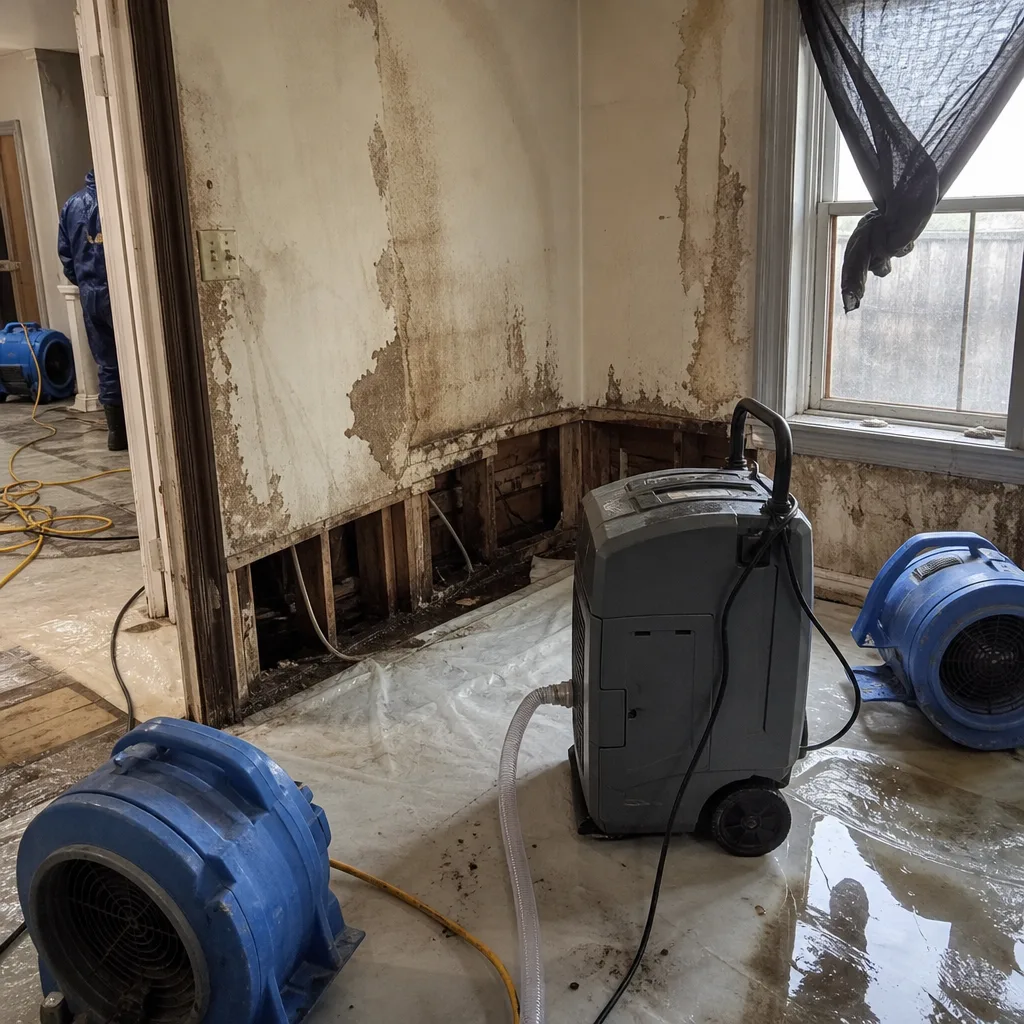 Before
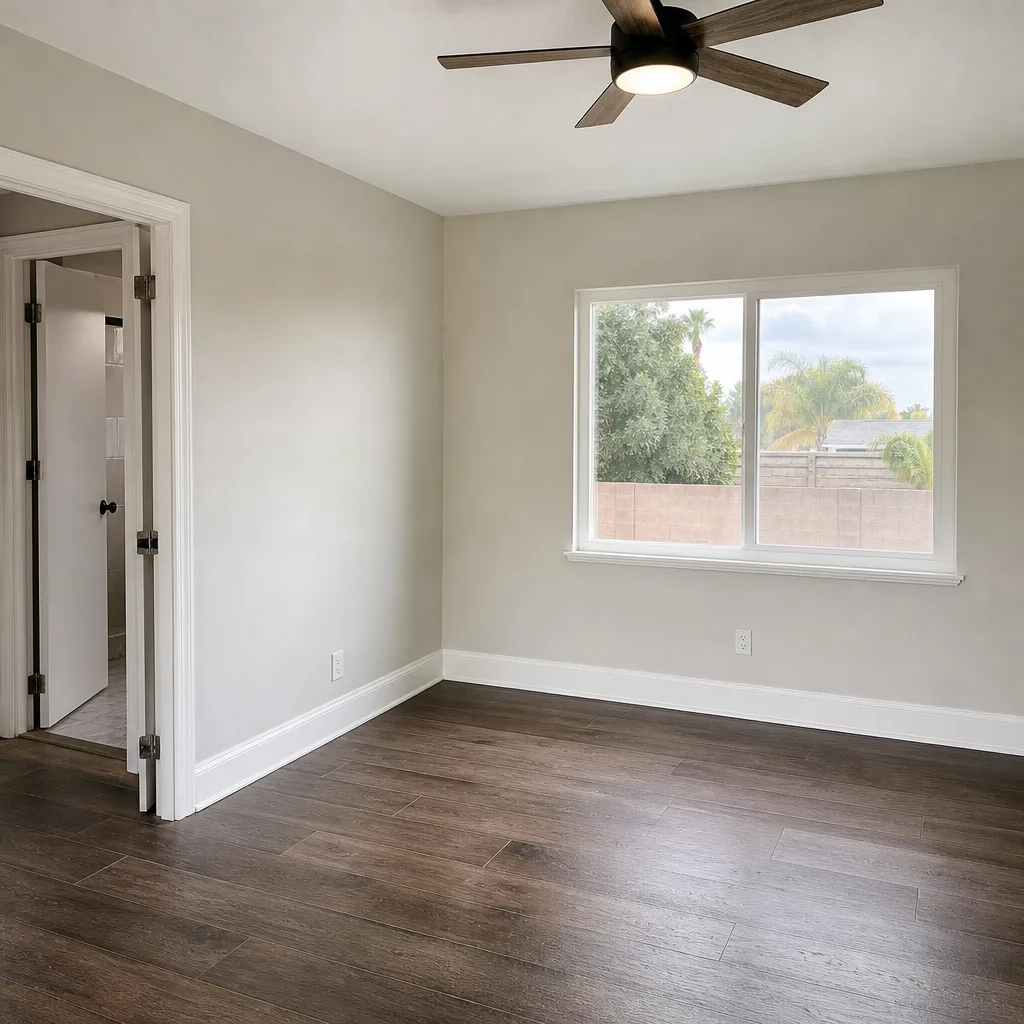 After
 Before
 After